
A photography portfolio or (online portfolio) is a collection of images (usually professional) that includes training, education, qualifications, beliefs, testimonials, references, etc.
By showcasing technical skills and education alongside one’s artwork, photographers can provide tangible evidence of their potential to their customers, clients, and employers, differentiating themselves from their peers.
It’s also important to note that clients and employers only want a summary, description and validation of who you are rather than a description of your company or who you hang out with.
Last year, I reviewed hundreds of professional online photography portfolios worldwide and found that most were just a collection of pictures and nothing more. The remainder had too much-written info with no validation or photos, while other sites could have been better designed and easier to navigate and read.
Below, I’ve listed essential vital elements that should be included within a photography portfolio and how best to describe yourself.
Career Summary
A career summary briefly describes what you do and what makes you unique and stand out. Keep the summary factual and informative but at most five sentences long. Below, I’ve included an example:
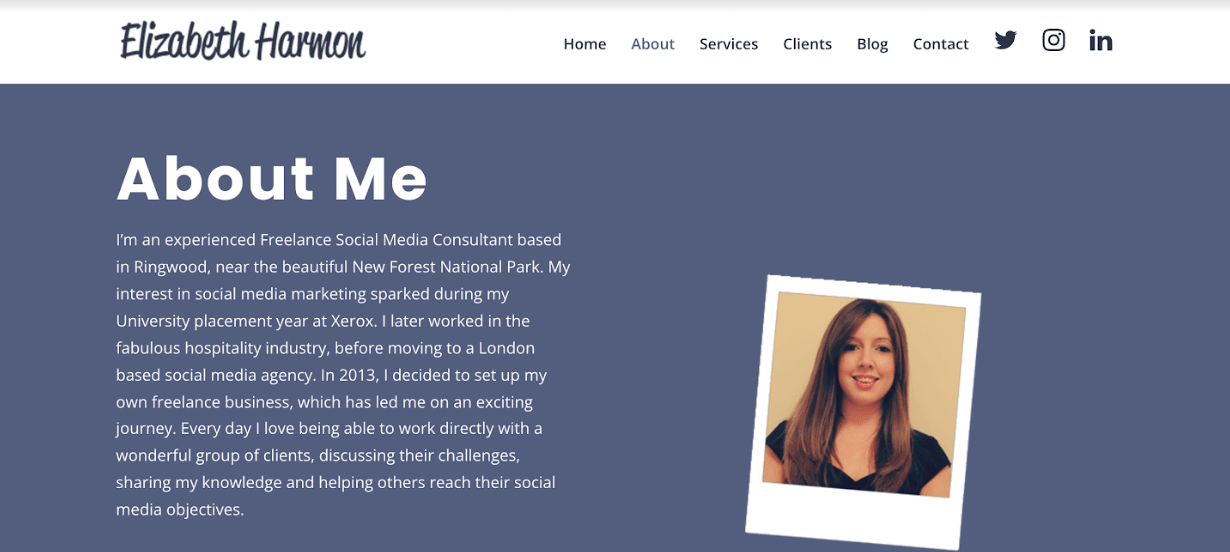
“An accomplished photographer with a proven ability to meet deadlines. I’ve worked on several journalism projects that increased magazine sales through fact-finding photojournalism investigations.”
Mission Statement
A mission statement is a short description explaining why you or an organisation exists, your overall goals, your products and services, and your primary customers and market.
A mission statement should be kept short, including an introduction, a body, and a conclusion. Below, I’ve included an example:
- Introduction.
Tell your employer/clients your core beliefs and why you do what you do.
- Body.
Tell your employer/clients about your values and why they’re essential.
- Conclusion.
Summarise your values and what you wrote in your body.
Below is an example of a mission statement that’s brief and to the point in eight sentences:
“I trained to be a health and fitness photographer because I love educating people about exercise and healthy eating. The best and most important part of my job is to help people improve their health as they start to make healthier life and diet choices. With the number of illnesses rising through unhealthy eating and poor living, I’m grateful that I can make a difference in people’s lives.”
Biography
A biography may benefit your client or employer by showcasing who you are and your personality. Moreover, it helps to establish a human connection between you and your client/employer. Bios must be informative rather than dull. Remember, you’re trying to sell yourself and your work, not your pet dog or your love of knitting.
A good bio should focus on these critical elements:
- Focus on what’s most important, e.g., are you writing a bio to gain a job?
- Use the appropriate voice when writing, e.g., he/she/they/full name did, etc.
- Use storytelling elements, e.g. share how you overcame an obstacle in life. Grab your audience’s attention.
- Include humour, e.g. make your audience/employer/client laugh.
- Is current, e.g. include all recent positions or achievements.
- Include links to examples of your accomplishments, e.g. hyperlinks to samples of your work.
- Include your contact information, e.g., your contact information at the end of your biography, including your email, landline and mobile number, personal website, etc.
- Be unique, e.g., avoid using the same biography for every job application. Tweak your bio for each job application.
Here’s an excellent example of a short bio:
“Friends and family see me as a photographer, writer and businessman. I’ve been all of them at some point in my life. After years of working in the journalism and photography industry, I found myself downsized a few years ago. I launched a few home-based photography businesses specializing in portraiture and online proofreading, including one where I went to small businesses to help with business branding. Since then, I’ve published my book about portraiture photography and branding, and I also help small businesses build websites to attract their target audiences. Furthermore, I also run photography workshops for disadvantaged children and adults looking to excel in life. Links to my work and accomplishments can be found here via my website.”
For more information, please get in touch with me at jon@example.com
Contact telephone:
Address: 23 Example Street, England.
Marketable skills and abilities
Clients and employers want to see evidence of skills and abilities; however, it’s important not to go overboard here. For example, only include skills and abilities you’re most proud of.
Below, I’ve listed a few examples, such as:
- Management skills.
- Team building.
- Leadership.
- Voluntary work.
Describe precisely how you use these skills, such as:
Management Skills
“I managed a team of several photojournalists for a national news and media company in which we, as a team, covered unfolding stories for the public. In this role, I taught myself communication, problem-solving and decision-making skills, which were critical for this role as a lead investigative journalist managing a team of seven men and women.”
Voluntary Work
“I spent three years volunteering as a photographer for a local veterans PTSD recovery project, helping ex-military personnel to get back on their feet again to find new work in the photography industry or to use photography as a coping mechanism for anxiety and stress. I learned good rapport skills to build a trusting relationship with people, problem-solving to overcome specific clients’ anxieties and leadership that helped me to help them move forward in life.
Professional Accomplishments
Keeping this portfolio section easy to read is essential, separating your professional accomplishments into categories. Furthermore, it’s important to add plenty of detail.
When creating your list of accomplishments, don’t write things such as:
“I’m an award-winning photographer seven years over in all four genres, with Master Craftsman status.”
While this is an excellent achievement in making you sound confident, it lacks depth and could be misinterpreted by some as somewhat condescending. Therefore, try to apply more depth and clarity, such as:
“I achieved the Photographer of the Year competition at a national level with the Guild of Photographers seven years running in all four categories covering portraiture, natural world, landscapes and photojournalism. In addition, I garnered my Master Craftsman status, which indicates knowledge of the craft to a level where the Guild of Photographers is willing to recognise me as an Ambassador of the Association.”
That reads so much better; it’s informative, formal, catchy, and admiring, and it will undoubtedly catch the eye of your client or employer. However, it’s also important to back these claims up with evidence.
For example, could you include links to your work and achievements in each category?
Finally, when writing down your achievements, please separate them into bullet points.
Samples of your work
This section of your portfolio must illustrate reports, articles, news, reviews, presentations, projects, etc, that you’ve compiled throughout your career.
You can include links to reports, presentations, images, footage of you working on a project, graphs, charts, assignments, etc.
For example, if your job is a health and fitness photographer, include links to blogs you’ve written about food photography, equipment setup, presentations, talks about fitness photography, and articles detailing your work in the local or national press and media.
If you’re new to the photography industry and have little to show, you could include links to work experience, assignments, or work you’ve done with organisations.
Also, could you include any feedback such as testimonials, customer reviews, or feedback from companies you’ve worked with?
If you cannot link back to anything, such as a customer review, could you include it in a paragraph with the customer’s name and contact details as a reference?
Awards and honoUrs
This section of your portfolio allows you to shine out among the competition. For example, scholarships, photography awards, and honours are included here. Employers looking to hire you will always spend time researching this section to predict your future performance and if you’ve potential for promotion.
Here are some tips on what to include:
- Only include significant awards, e.g., awards of great importance that only some people in the photography industry can achieve.
- Please include the title of the award, recognition level, and the date you received it, e.g., Great Britain’s 2024 Photojournalist of the Year Award for Conservation Photography.
- Use verbs such as “garnered”, “achieved.”, “earned” when describing how you won your award, e.g. I achieved the Sports Photographer of the Year Award in 2024.
- Explain the impact of your achievement, e.g., explain the situation that led to your accomplishment, establish what the task or goal you set out to achieve was, walk your employer through the action or actions you took, and finally, discuss the results of your action, as well as the affects your accomplishment had on you or your company.
- Quantify your accomplishments, e.g., you were the only one chosen for this award out of 200 of the country’s renowned photographers.
There’s no specific limit to the number of awards or honours you should include in this section of your portfolio, though I would like to point out that you should only have your recent accomplishments to hand here.
For example, if you’ve won several prestigious awards and honours in the last year that took hard work to achieve, then by all means, include them all.
However, don’t include prestigious awards you garnered several years ago because it may prompt your employer to question gaps in your work history.
Proof of Qualifications
This portfolio section should contain links to actual photos or documents of your certificates, licences, etc, rather than just descriptions.
For example, include links to photos that illustrate you have a diploma in photography, are a licenced journalist with the NUJ, etc.
Please don’t include links to photos that show you’re a member of a Facebook forum or a paying member of a photography organisation, etc.
There’s a big difference between a qualification and being a member of an organisation.
A qualification or licence means you’re qualified/licenced to do a specific job, whereas being a member of a group, paid or unpaid, means just that; it’s not a qualification, nor should being a member of a group/organisation be used to lead an employer or client up the garden path.
Don’t panic if you have no certificates or qualifications to prove you’ve studied photography, and under no circumstances don’t leave this section of your portfolio blank.
If you could instead, please include links to samples of your work, projects you’ve worked on for clients or companies, images/photographs, project summaries, and reports, or consider using work from school or voluntary projects.
Professional Development
Unlike clients you provide a service to, employers like to see an individual who is passionate about their work, is keen to learn new things and has ambition.
In this section of your portfolio, you can include a list of associations you’re a member of; for example, I’m a member of the Guild of Photographers, among other institutions.
You could also include links to seminars, conferences, workshops, etc, you’ve spoken at (make sure you are in the footage) and that the footage is clear and audible. You could also include links to YouTube workshops, talks, presentations, etc.
I’ve included an example below.
- Member of the Guild of Photographers.
- How to set up a portrait background on YouTube.
- 2018 TEDx conference about conservation photography.
Military Records, Awards & Badges
Show your employer your military honours, high standards, and commitment to excellence. Show any commendations, awards, badges, honourable discharge, or other special recognitions in your career portfolio via links to photographs.
Voluntary Work & Community Service
This section of your portfolio is by far the most important.
Every employer and client loves to read or hear about the voluntary work you have undertaken past and present, whether it’s feeding people experiencing homelessness, cleaning the streets and woodland, or helping vulnerable and disadvantaged people.
This experience looks great on your Curriculum Vitae (CV) and portfolio because it shows you’re reliable, committed, responsible and a good team player–all traits employers love!
Including volunteer work on your CV or portfolio is as essential as adding your skills, education, qualifications and experience.
In addition, it’s also a great backup if you’ve little photography experience because it shows your employer how you utilise your skills and abilities in the real world.
Add your voluntary work via bullet points (see example below), including the dates and the company you worked for. You could also include links to any video footage, press, and media coverage you garnered from volunteering.
- 2014 – Feed people experiencing homelessness with a local charity from 2014-2015 during the winter months.
- 2016 – Volunteered on a vulnerable persons unit at a local drug and alcohol rehabilitation centre; see video here. I taught local people going through detoxification photography as a coping mechanism for anxiety and depression. My work is featured in the local press (add link here).
- 2018 – Volunteered with my local Green Party to clean the woodlands of litter and junk (include the name of the organiser here). The team I was working in was also featured on the local news media channel (add link here).
References & Testominals
Include a list of up to three to five people you’ve worked with or know. Be sure to include their job titles and contact information.
You can also share testimonials from clients you’ve supplied a service, customers, professors, colleagues, or previous employers who have highlighted your best qualities. In addition, you can also showcase copies of positive employer evaluations or reviews.
If you’ve no work experience, for example, fresh out of school, college or university, then include a list of people who know you well and have provided positive reviews about your educational work.
How you highlight your references and testimonials is entirely up to you, though keeping it easy to read and honest is critical.
Next Steps
Once you’ve created your portfolio, you must customise it for each job application, interview or targeted clientele.
Look for critical skills and accomplishments each employer mentions in its job listing and adjust your portfolio to highlight these items.
If your portfolio is purely to garner new customers for your business, include case studies, testimonials, blogs, samples of your best work and even a project you’re currently working on. These are vital elements.
Updating and improving your career portfolio at least once a year is also a good idea.
Regularly reviewing your portfolio will enable you to add new information while it’s still fresh in your mind and remove items that have become outdated. It’s also an excellent way to monitor your progress and identify areas to work on.
It’s also worth noting that your portfolio should be displayed on its own personal and fast-speed website and not that of a company or organisation site.
This is because your client and employer want to see who you are, your skills, education validation, etc.; the last thing you want is for them to focus on a notification regarding a customer buying a product, for example, or a slow-loading page.
The choice of site is entirely up to you. However, it’s always best to maintain a professional appearance that is easy to read.
Choosing the right font to write with is essential, as is the element layout.
In recent years, I’ve used WordPress as a site builder, implementing my own coding and tweaking; it’s cost-effective and easy to work with. Furthermore, WordPress has hundreds of plugins, templates, and customisation options to improve and modernise your portfolio.
Without sounding too harsh, one of the most irritating things I and other photojournalists have found when reading portfolios is text layout.
Maintaining a straightforward and easy-to-read portfolio is very important. Therefore, a comprehensive screen text layout will distract most employers and clients.
Conclusion
With the help of a well-organised online portfolio, employers and clients can learn about candidates’ work history and verify their skills.
There are several advantages regarding online portfolios, including but not limited to the following:
- Exposes you to various fields and positions, setting you apart from other job seekers.
- Online portfolios are a professional way to showcase your skills and work.
- It’s a great first impression for employers and clients.
- Building your online portfolio demonstrates to employers you have some, if not excellent, IT skills.
- Increases your visibility and presence.
- Shows you’re more than just a resume and/or Curriculum Vitae.
- Online portfolios give you more flexibility; for example, with the click of a button, you can change content, videos, images, etc. Furthermore, you can create new content and tweak your online portfolio to match the job roles you’re applying for.
As with all things in life, online portfolios have a few disadvantages. Including but not limited to the following:
- Portfolios take time, effort and lots of patience, such as website maintenance and updates, responding to enquiries, and ensuring the website functions correctly.
- Building your online portfolio can be costly, too. While there are free and low-cost website and web-building options, they often come with restrictions such as bandwidth, data, etc. Therefore, you may have to upgrade depending on what content you want to include, i.e. videos, high-resolution images, etc. In addition, there may be additional costs for domain registration, hosting, and premium features or themes and plugins.
- With so many personal websites, standing out and driving traffic to your site can be challenging. Therefore, you may need to invest in marketing and SEO efforts to improve visibility.
- Online portfolios come with a few technical challenges; for example, only some people are comfortable with web design, so creating a professional-looking online portfolio may require learning new skills or hiring a web developer, which can be costly.
Thank you for reading; please subscribe for free, and remember, sharing is caring.

J. J. Williamson – The Norfolk Photographer
Jon Williamson is an ethical Norfolk-based award-winning photographic journalist with over fifteen years of experience in the photography industry, specialising in portraiture, boudoir, flora, landscapes, prints, frames, etc. For more information, please email the Norfolk Photographer below.